
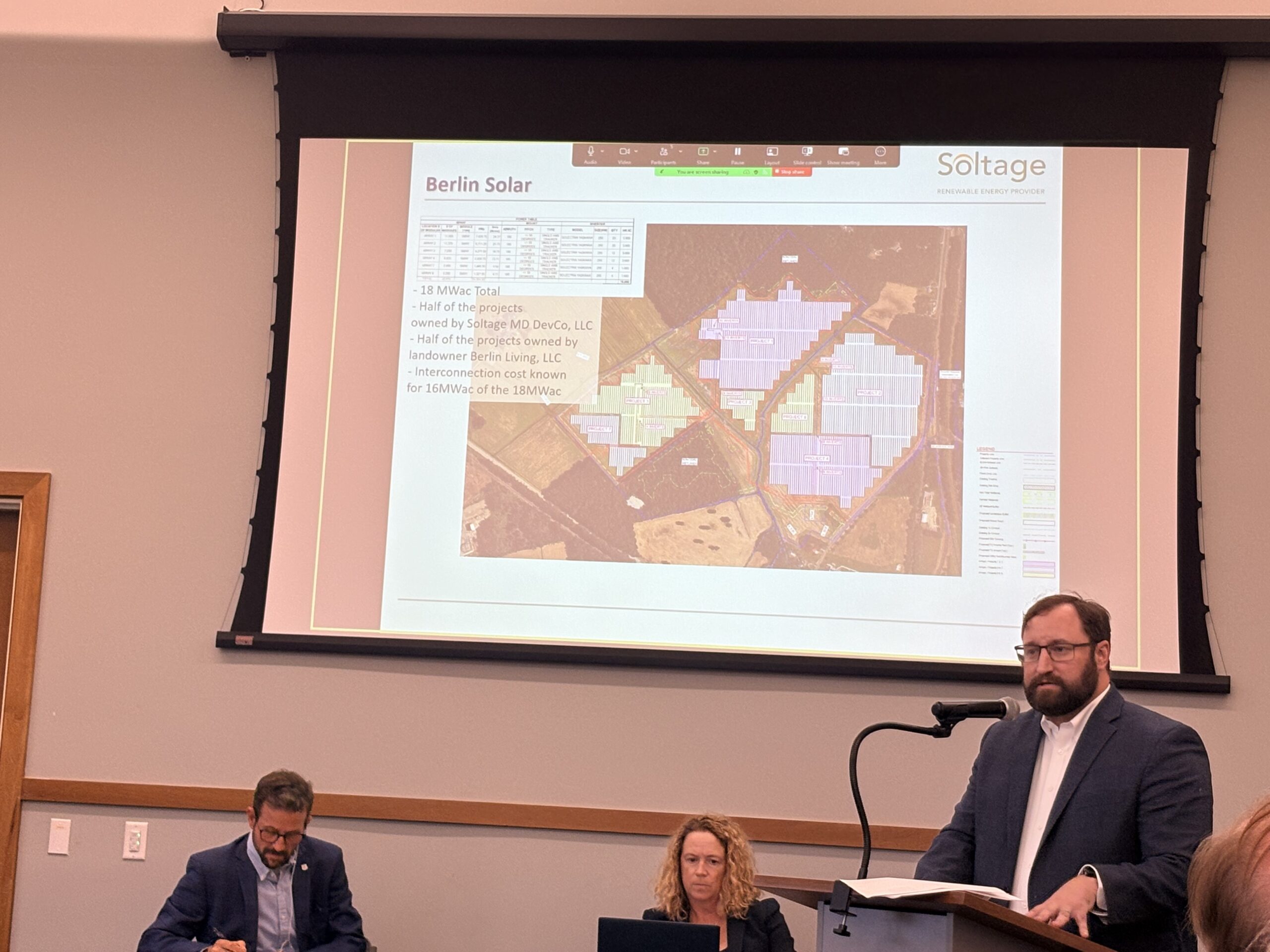
An engineer, representing Kimley-Horn and Soltage, outlined the solar project for about a dozen residents in attendance last Thursday.
PSC staff recommending approval of 18-megawatt project north of downtown
By Brian Shane
Staff Writer
(Sept. 3, 2026) A proposal to build what would become Worcester County’s largest solar farm has won the backing of state regulators as the state’s Public Service Commission moves closer to a final decision.
Public Service Commission staff and the Maryland departments of Natural Resources and the Environment are recommending approval of the 18-megawatt project, proposed for a site just north of downtown Berlin.
Their recommendations for a proposed solar array from New Jersey-based developer Soltage were presented Thursday during a public comment hearing at the Berlin branch of the Worcester County Library.
The project would cover about 113.7 acres of a 157-acre property at the northwest corner of Routes 50 and 113. The property is zoned for industrial use but is now being farmed.
Seven people spoke. Some residents questioned the loss of farmland, while a statewide environmental group supported the project as a source of cleaner and more affordable energy.
Berlin resident Andrew Cadogan said he was not opposed to solar energy but argued that panels should be installed atop existing structures instead of taking agricultural land out of production. As an example, he mentioned the solar-covered parking area at Wor-Wic Community College in Salisbury.
“We’re giving up a huge tract of land,” Cadogan said. “I don’t understand why we are not going the route, like they did with Wor-Wic, where we’re covering already developed areas, parking lots, buildings, and areas that are not farmland with these solar developments.”
Brian Gilliland, an Eastern Shore clean-energy organizer for the Maryland League of Conservation Voters, said community solar offers subscribers discounted electricity while helping Maryland reduce greenhouse-gas emissions.
“Marylanders are listing energy affordability among their top concerns, and community solar is a smart solution,” Gilliland said. “This project reflects the kind of thoughtful, forward-thinking energy development that Maryland currently needs.”
The Town of Berlin has not taken a position for or against the project.
District 1 Councilman Steve Green said the town still wants details about how the land would be restored once the solar farm reaches the end of its working life, a process known as decommissioning.
“Decades from now, we feel strongly that Berlin’s taxpayers and neighboring property owners should not inherit the responsibility for removing this infrastructure,” Green said at the hearing. “We are unaware at this point what the decommissioning plan is.”
Green’s district includes the project site. He requested that a copy of the developer’s decommissioning plan be sent to the town so it could be shared with residents. Green is also the editor of this newspaper.
Soltage’s paperwork with the state calls for the estimated cost of decommissioning, minus the equipment’s salvage value, to be recalculated every five years. The developer previously stated it would post a bond to cover the cost of decommissioning.
Project engineer Nick Leffner said the developer estimates the project could generate about $8.5 million in tax revenue for Berlin and $910,000 for Worcester County over its operating life, compared with approximately $130,000 from the land’s current agricultural use. The state application says the project could operate for 30 years or more.
Berlin resident Bob Mitchell, who is also Worcester County’s director of environmental programs, questioned those projections. He said comparing the solar project with the property’s current agricultural use did not account for its industrial zoning or the tax revenue and jobs that another type of development could generate.
Maryland generally limits individual community solar projects to 5 megawatts but allows multiple projects to share the same industrially zoned property – an arrangement known as co-location.
Soltage’s proposal consists of six separately connected arrays: two producing 5 megawatts, two producing 3 megawatts, and two producing 1 megawatt.
Plans call for landscaped buffers, agricultural-style fencing, and preservation of the property’s topsoil. Soltage previously said construction could begin next year after state approval and more local permitting.
Thursday’s meeting was the project’s second public comment hearing. The first was held June 22 at a community center in Willards.
The project still needs approval from the Public Service Commission. Before it makes that decision, a judge will hold a formal hearing at 10 a.m. Oct. 1, when the parties can present evidence and question witnesses.