
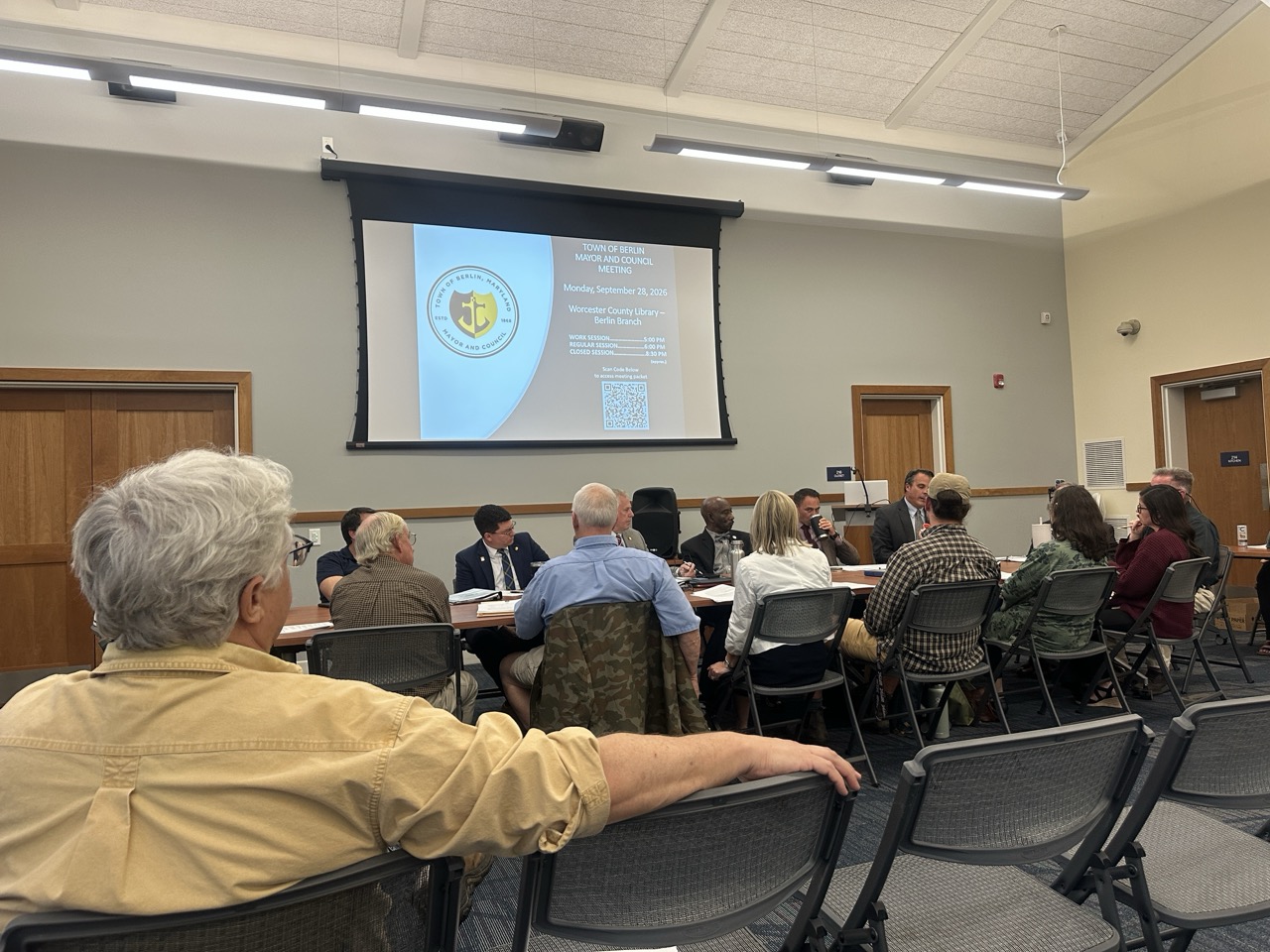
Members of the Berlin Mayor and Council and Planning Commissioners are pictured on Monday night.
By Tara Fischer
Staff Writer
(Oct. 1, 2026) Berlin officials have approved the town’s guidelines for accessory dwelling units, establishing requirements for their size, occupancy, design, and construction ahead of a state-mandated Oct. 1 deadline.
The Town Council approved the ordinance unanimously at its meeting Monday following a joint work session with the Berlin Planning Commission and mayor earlier that night. It was the second work session in two weeks as officials rushed to finalize the municipality’s regulations before the state’s Oct. 1 deadline.
The law, passed by the General Assembly last year, requires municipalities to develop local provisions for ADUs—apartment-like structures detached from a lot’s primary home—in the hope they could offer additional, more affordable housing options.
The new law also stipulates that a local government’s regulations cannot be so restrictive that property owners are financially or otherwise prohibited from building an ADU on their land.
Berlin began developing its guidelines earlier this year, with discussions in February and September addressing unit sizes, parking, design standards, and other requirements.
Under the approved ordinance, ADUs must be between 350 and 600 square feet of livable space, and only one unit is permitted per lot. The regulations require ADUs to provide independent living facilities, including permanent provisions for cooking, sanitation, sleeping, and bathing.
Additionally, the ordinance allows a maximum of two adults and up to two children or wards age 17 or younger to occupy a unit.
Officials spent part of Monday’s discussion clarifying the definition of an ADU, particularly in cases involving existing pool houses or other accessory structures that might contain some residential features.
Planning Commission Chair Matt Stoehr said a structure with sleeping quarters, a kitchen equipped with a full stove and a full bathroom could qualify as an ADU. Officials discussed distinguishing such units from pool houses or other structures that lack complete living facilities.
The ordinance also establishes that a detached ADU may be constructed at the same time as a primary residence but cannot be occupied until the primary dwelling is fully constructed and ready for occupancy.
Officials discussed how the regulations would address properties with existing structures that exceed the new size limit, as well as how the town could bring previously unauthorized units into compliance.
The ordinance includes a limited amnesty program for qualifying detached ADUs constructed and used as dwelling units before Oct. 1, 2025.
Property owners seeking amnesty must submit an application with photographs documenting the unit’s interior and exterior to the town’s planning director by April 1, 2027.
According to the approved policy, applicants must demonstrate the structure’s original construction date and continuous use, verify compliance with applicable electrical and plumbing safety standards, and meet structural requirements within an established timeframe. Applicable impact fees must also be paid.
The amnesty provision does not authorize expansions or structural alterations. Units exceeding 600 square feet but measuring less than 1,200 square feet may qualify for amnesty only if the required impact fee is paid during the amnesty period. The provision also restricts qualifying units to one bedroom and one bathroom.
The ordinance also addresses parking and stormwater management.
Applicants are strongly encouraged by local government to provide one dedicated off-street parking space for each ADU.
As for stormwater, provisions encourage property owners to incorporate on-site facilities capable of capturing additional runoff generated by the unit and associated impervious surfaces during a 10-year storm event.
Recommended measures include rain gardens and dry wells.
Once authorized, ADUs will also receive a separate half-address attached to the primary dwelling’s address to help emergency services identify the unit.
Design standards will require review by the Berlin Planning Commission, including consideration of materials, windows, proportions, and screening. Properties within Berlin’s historic district must comply with historic design requirements.
The approved fee schedule establishes a $300 application fee in fiscal 2027. Permit fees for newly constructed ADUs will begin at $500 in fiscal 2027 and increase to $575 by FY 2030. Converting an existing accessory structure into an ADU will cost $350 in FY 2027, rising to $425 by FY 2030.
An additional certificate covering zoning, occupancy and the required covenant will cost $150 in FY 2027, increasing to $165 by FY 2030.
“I think there’s a lot of good substance in this ordinance that sets Berlin up in a good way within the confines we have to comply with,” Berlin Mayor Zack Tyndall said.