
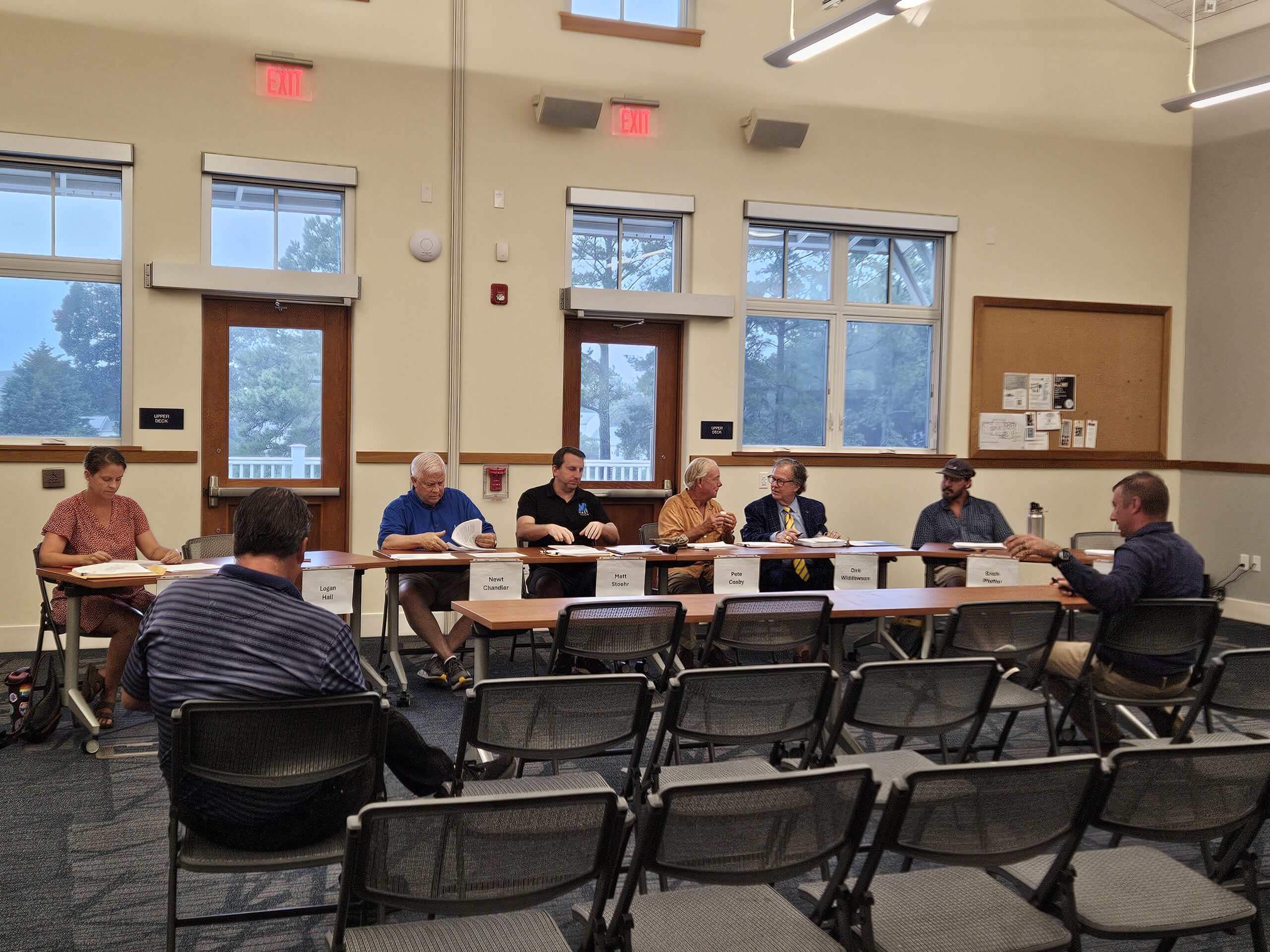
Mead & Hunt’s Will White is pictured before the Berlin Planning Commission on Monday night.
By Bethany Hooper
Associate Editor
(Sept. 3, 2026) A discussion on the town’s potential conversion to a form-based zoning code dominated this week’s work session on Berlin’s draft comprehensive plan, with some town planners arguing for a more modern approach and others arguing for the preservation of existing residential areas.
On Monday, the Berlin Planning Commission held a two-hour-long meeting, in which representatives from Mead & Hunt presented the first iteration of the town’s draft comprehensive plan, the document that outlines Berlin’s vision for growth, investment and preservation in the coming years.
While the presentation touched on a broad range of topics, from transportation and community facilities to water resources and municipal growth areas, the bulk of the meeting focused on one of the plan’s recommendations – transitioning to a hybrid form-based zoning code.
“Instead of regulating the traditional type of zoning, regulating the usage of the property – industrial here, residential here, single-family there, multifamily there, business over here – you regulate based on the form,” Project Manager Will White said. “So does this building fit the neighborhood?”
Zoning based on structure’s form considers the physical appearance of a building and its relationship to its surroundings. The use of that building is a secondary consideration. The first consideration in traditional zoning whether the use of a building is compatible with the other properties around it.
Over the spring and summer months, White said his firm solicited feedback from the town’s residents. Results from a community survey, he said, revealed transportation to be a top priority, with 96% of respondents wanting more or better sidewalks.
“That was honestly the closest we’ll get to 100%,” he said. “I’ve never seen numbers that high.”
But behind transportation, White said, was the desire to prioritize aging infrastructure (83%), prioritize housing renovation and reuse (82%) and preserve the neighborhood character (74%).
“Nobody was really opposed to infill development, no direct opposition to it, nobody opposed to growth in general,” he said, “but it was that we want the town’s character to remain. We want Berlin to look like Berlin.”
White also shared the results of both a community workshop and a popup event. During those outreach events, community members talked about safe walking and biking opportunities, a desire to expand the downtown area, and the lack of affordable housing, to name a few.
“Everything kind of fell into three categories,” White said. “What do the residents of Berlin really want? They want to grow thoughtfully, connect safely and protect what matters.”
Talking about growth and land use, White said the comprehensive plan focused on infill development and promoting “thoughtful density.” He said that includes using more understandable zoning tools that can guide growth without sacrificing the town’s character.
Specifically, the comprehensive plan proposes new “character” areas, which include a historic downtown core, a mixed-use corridor, and a neighborhood residential district. It also recommends moving toward a form-based zoning code.
“Form-based code is basically land use zoning as based on the form, or the architecture and design of the development,” Mead & Hunt’s Allysha Lorber said, adding that use was secondary but could still be a strong element. “The idea is to give more flexibility to developers to be able to implement the kind of development they want to build.”
Essentially, the consultants argued the transition could improve walkability, increase housing options and support infill development, so long as it matches the design of neighboring properties. Planning Commissioner Newt Chandler, however, argued that use should be the priority, adding that a form-based code would ruin the town’s quality of life.
“Seventy-four percent say they want the character of neighborhoods to be preserved …,” he said. “Form-based neighborhoods like you are proposing here, the way you are talking about it, could wreck that.”
Lorber said the town could take a hybrid approach, where form-based zoning would apply to some areas and not others. She added that it could also support infill development in underutilized areas.
When asked if infill development included accessory dwelling units – which, by law, are now allowed by right on single-family lots – Lorber said it could.
“One of the things we heard over and over is more housing, more affordable housing …,” she told commissioners this week. “What we are saying is there can be more opportunities for infill development in the downtown area, and in the neighborhoods, and in all of these areas really.
Simply put, Lorber said the hybrid zoning could create more housing types, at different price ranges. She said the average house price in Berlin currently prohibits some young families from moving to town.
“When you talk about affordable housing, in Berlin today, you have a situation where young kids who are growing up to become young adults, a young family, cannot live where they grew up …,” she said. “Berlin is very difficult for families to start off here, and that’s one of the things we want to address. We want to make housing options attainable for more types of people.”
Chandler, alongside Commissioners Dirk Widdowson and Pete Cosby, shared their concerns over form-based zoning, with Chandler stating he did not want to see a triplex or office built next to his house and Cosby saying he did not want density and compression to affect Berlin’s character.
Chandler and Cosby added they were more concerned about the residents who currently live in town, and not the ones who would want to eventually move there.
“You have people who want to live here and people who can’t afford to live here,” Cosby said. “The people who live here are the ones that matter.”
Commissioners Logan Hall and Jenelle Gerthoffer said they supported the hybrid approach but had concerns about the staffing needed to oversee it. Hall added that it gave developers more opportunities and put guardrails on future growth.
“We can’t close the gate and say no one is coming into the town of Berlin,” Hall said. “In 10 years, there’s going to be growth. This is defining how that growth is going to go.”
Following a lengthy review of the draft plan, the consultants agreed to come back with a revised document, one that would modify and “subdue” sections where form-based zoning is proposed. Hall said he also wanted to see the plan put more focus on transportation, as sidewalks were a top priority for residents in the community survey.
“Almost 100% of people that gave feedback, safety, pedestrian and bicycle safety is the top priority …,” he said. “The plan should put that in the forefront, that this is the town’s priority.”
The town’s updated comprehensive plan is expected to go before the town council for approval later this year. The document will also be submitted to the Maryland Department of Planning for review.
In-depth information including the process can be found here
The presentation made at the meeting can be viewed here